
The thing about straightforward applications is that they’re only straightforward until the doors open and the meeting starts….
I’d filed it under the usual rural infill: four houses on a logical gap in a mid-size village. Nothing exotic. The officer was supportive. No tricky policies, no neighbour letters (at first), no third-party ecology reports. I’d even written my five-minute committee speech in full — a rare indulgence, usually reserved for bigger schemes or jittery clients.
We were recommended for approval. And as any planning consultant knows, this is about as reassuring as being told you’re unlikely to be shot before dinner.
I wasn’t expecting trouble. I’d pressed my shirt – even put on a tie. My client had said “should be a formality” out loud, which in hindsight may have cursed us all.
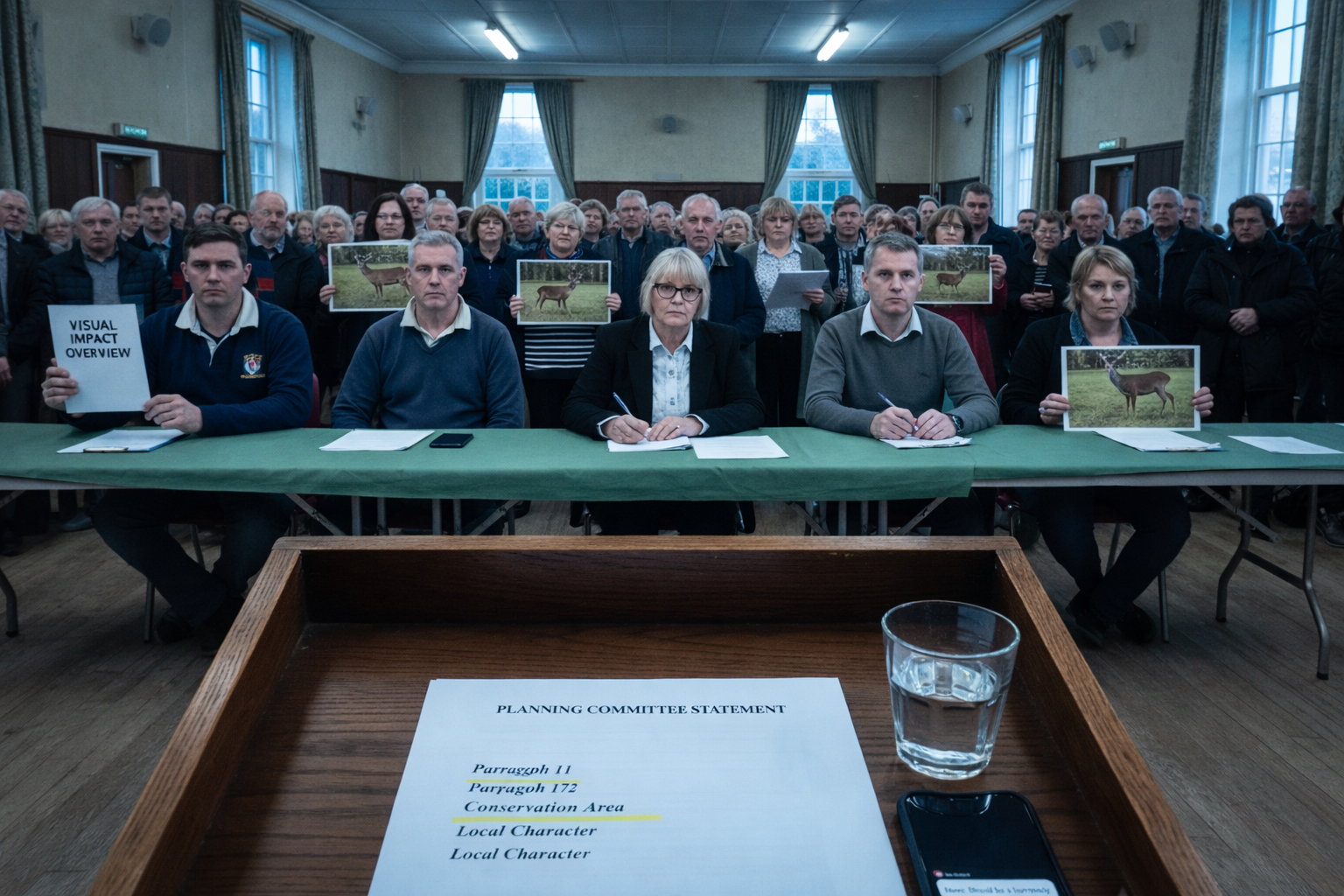
The car park was full. I circled twice before abandoning the car somewhere near a grit bin. Inside, the room was busier than I’d seen it since that infamous Persimmon application on the chicken farm. There were clipboards. There were laminated photos. Someone had brought a binder. A man in a rugby fleece was handing out something called a “Visual Impact Overview,” which appeared to be three printouts of the same Google Street View image, each annotated with the phrase “too dense.”
My client was sitting bolt upright, staring straight ahead like someone waiting for a verdict. The case officer looked up and mouthed “sorry” without moving his lips. I hadn’t even sat down and already knew we were in trouble.
The first speaker stood. She read from a prepared script in a tremulous voice, pausing occasionally for dramatic effect or possibly to blink away rage. She said she wasn’t anti-development — they never are — but was “deeply concerned about overdevelopment, loss of rural character, and the pressure on already overburdened drains.” The drains were mentioned four times. The phrase “human waste” was used twice.
The second speaker was a professional. Not in the planning sense, but professionally outraged. She’d laminated her statement. Referred to the site as a “village lungspace,” which I knew was nonsense but still found oddly convincing. She mentioned deer. She mentioned the “flow of hedgerows.” She said the development would “urbanise the rural edge,” and pronounced “vernacular” as if it were a disease.
Then the councillor stood. Not local to the village, but local enough to care deeply and opine freely. He shuffled some notes and opened with: “I’m not against development per se, but…” followed by five minutes of reasons why, in this specific instance, he was very much against it.
He was concerned about precedent. About access. About the shape of the roofs. At one point, he described the proposed design as “akin to a motorway service station with aspirations.” The crowd nodded. One woman clapped before remembering herself.
Then it was me.
I stood. I delivered the speech — the well-paced, well-argued, well-mannered five minutes that no one wanted to hear. I talked about housing need, spatial strategy, policy compliance, the infill nature of the site. I referenced paragraph numbers. I said “in keeping with the grain of development.” I tried not to sound smug.
I was thanked, politely. A man in the front row looked at me like I’d just confessed to poisoning his dog….
Then came the debate.
Except there wasn’t one. A councillor moved refusal the moment the chair inhaled. Another seconded. The reasons? “Out of keeping.” A vague reference to “local concern.” A comment about the importance of “preserving the edge.”
The officer tried — gently, professionally — to steer things back. He pointed to the report. To the recommendation. To the plan. To the fact that it had no policy conflict. It didn’t matter.
The vote went: six to three. Refused.
My client didn’t speak. Just looked at me with the thousand-yard stare of someone who’d just watched their week unravel in slow motion. I offered a quiet “We’ll appeal. We’ll win.” He didn’t answer. He was already scrolling through his phone, possibly for another consultant or possibly for a whisky.
We stepped outside. The air was cold. Someone had put up a “Save Our Village” sign on a lamppost. I hadn’t even known it was under threat.
Back at the car — the one parked at an angle behind the grit bin — I sat for a while and re-read my speech. It was good. It was tight. It ticked every box, addressed every policy, referenced every concern. It was, objectively, right.
It just didn’t matter.
Because sometimes, in this job, you turn up with a perfect planning argument and lose to a laminated photo of a deer.
……And you drive home wondering if you can charge your client for five minutes of nothing.

Leave a Reply