Tag: politics

  • Green Belt: The Sacred Cow Grazing on Our Planning Future

    If land were religion, the Green Belt would be its high priest. Revered. Untouchable. Endlessly invoked in speeches and consultations as the last bulwark between concrete and countryside. Say the phrase “Green Belt release” in a public meeting and you can watch elected members age visibly before your eyes.
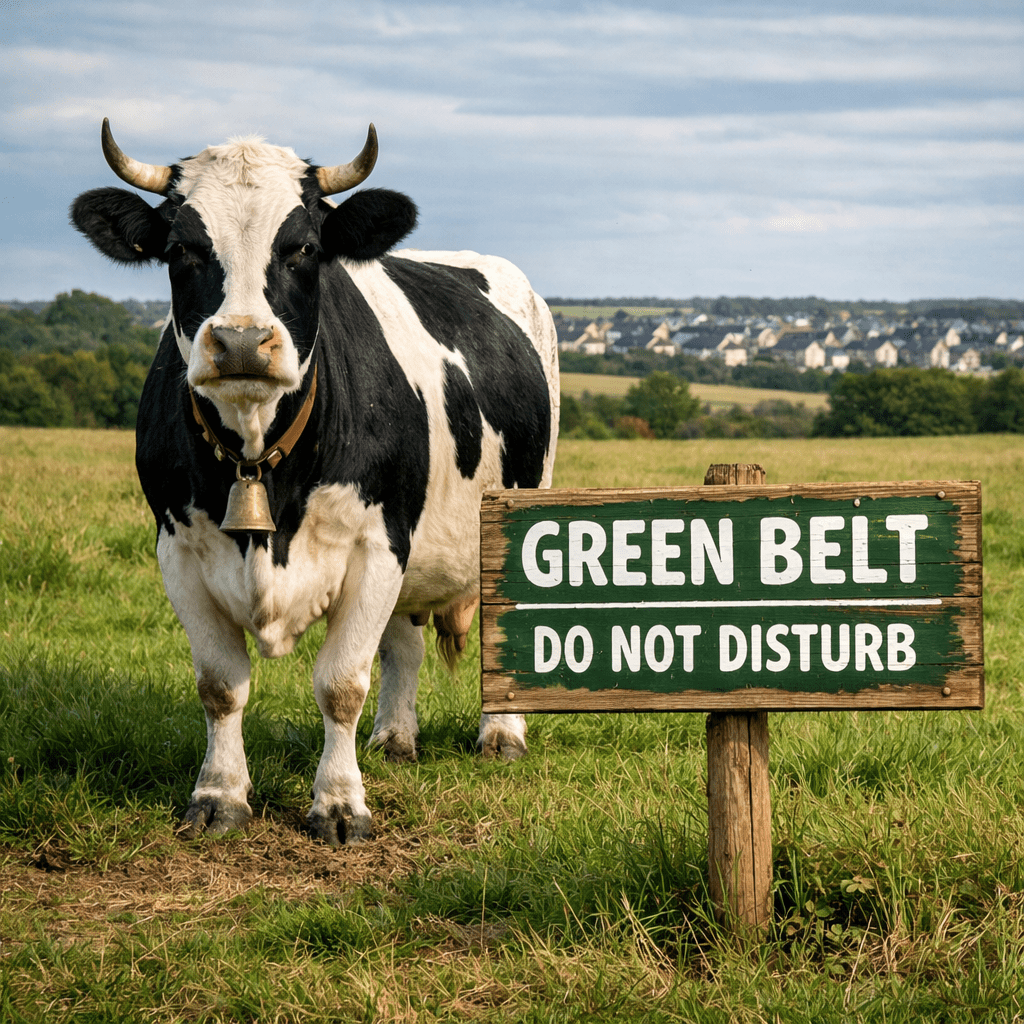
    But beneath the reverence lies a policy creaking at the joints, weighed down by decades of confused thinking, public misunderstanding, and political timidity. The question is no longer whether the Green Belt needs review — it’s whether we’re capable of admitting it.


    What Was the Green Belt For?

    The Green Belt wasn’t designed to be a beauty contest or a landscape designation. It wasn’t about protecting England’s green and pleasant land in general. It was a policy tool with clear strategic aims, introduced after the Second World War to:

    • Prevent urban sprawl
    • Protect the setting of towns and cities
    • Avoid the merging of neighbouring settlements
    • Encourage urban regeneration by containing development within existing areas

    It was, in theory, a bold and rational spatial device — a ring of restraint around major urban areas, shaping growth inward rather than outward.

    It wasn’t a promise that every green field would be protected. Nor was it based on ecological value, biodiversity, or landscape character. Yet over time, these misconceptions have grown roots of their own.


    Is It Still Doing That?

    In some places, yes. But in many others, the Green Belt is now doing something else entirely — and not always for the better.

    Rather than stopping sprawl, it often pushes it further out. Development leapfrogs the belt, landing in towns and villages beyond it. The result? Long commutes, car dependency, and splintered communities. Meanwhile, the inner edges of cities — close to jobs, services, and public transport — remain frozen, even where land is of low landscape or ecological value.

    The idea of “urban containment” works best when there’s a strong policy to build up, not just out. But the pressure on land and the scarcity of brownfield sites in many areas mean that containment has turned into constraint. And constraint, without direction, creates sprawl by stealth.

    It’s also worth saying — quietly, because this tends to ruin dinner parties — that not all Green Belt land is lovely. Much of it is unremarkable: intensively farmed, inaccessible, ecologically poor. You can’t walk through it, picnic in it, or enjoy it from a train window. It is “green” in planning terms only — and sometimes not even that.


    Why Don’t We Reform or Remove It?

    Because, quite simply, it is politically radioactive.

    Any attempt to review or redefine the Green Belt is met with howls of betrayal. National politicians know this, and local politicians feel it — in their inboxes, on doorsteps, at public meetings. Defending the Green Belt is electorally safe. Challenging it is not.

    Never mind that many people conflate Green Belt with “all green fields.” Or that they assume it’s about beauty, when it’s about boundaries. These myths are now baked into the public consciousness — and they’re not easily undone in a planning policy footnote.

    The result? Endless tinkering. “Exceptional circumstances” here. Strategic swaps there. Quiet incursions through local plans, but no national reckoning. We’re rearranging the deckchairs while pretending the ship is unsinkable.


    The Problem With Tweaks

    The idea of treating the Green Belt as permanent — as something beyond review — is oddly unplanning-like. Everything else in planning is negotiable. Everything else can be tested, balanced, consulted on. But the Green Belt is often treated as dogma, not policy.

    And when we do tweak it, we do so under immense pressure. Sites are carved out through bruising local plan examinations or court battles. The burden of proof is heavy, the politics even heavier. So instead of a rational, national conversation about growth, we end up with a patchwork of exceptions — each one fought for like a planning war of attrition.

    Meanwhile, homes are still needed. Infrastructure still ages. And policy limps on.


    What Might a Rational Policy Look Like?

    Start with a clean sheet. Ask: where should growth go, based on need, sustainability, connectivity, and environmental value?

    Some areas of Green Belt might still be essential — for setting, separation, or containment. But others, frankly, are candidates for review. And not because we want to pave paradise. Because we want to build homes in places that make sense.

    We should be protecting landscape, nature, and accessibility — not lines drawn in 1955 on the basis of how far a city had spread post-war. We should stop pretending that all Green Belt is sacred, and instead start treating it like the policy tool it was meant to be: strategic, revisable, and responsive.


    Conclusion: The Sacred Cow Needs a Vet

    The Green Belt served its time. It brought discipline to post-war growth. It helped shape cities and protect countryside. But we are now using it to fight a very different battle — against a housing crisis, against climate goals, against economic inequality.

    And in that battle, the Green Belt is not always on the right side.

    Yet despite the urgency, too often the loudest voices in the room belong not to planners, nor to those affected by housing need, but to local chapters of the CPRE — well-meaning, undoubtedly passionate, but often unqualified and unaccountable. Many worship at the altar of the Green Belt with a fervour that borders on the devotional. Their objections are predictable, relentless, and almost always against change.

    The question is: should we really allow such groups, however earnest, to shape national planning outcomes? Is it right that housing delivery, urban sustainability, and spatial policy should be hostage to those who view any development as a threat, and who see Green Belt as sacred ground, not strategic tool?

    It’s not heresy to ask. It’s just planning.

    Let’s stop treating the Green Belt like a relic beyond question. Because if we can’t even ask whether this tool is still fit for purpose, we’ve already given up on planning as a profession — and on homes as a right, not a privilege.
  • Planning Committees: Performance, Not Planning

    I’ve sat through too many planning committees to retain any romantic notions about what they are. Or what they were ever supposed to be.

    The theory, of course, is noble. That planning committees are a bastion of local democracy. That they offer a transparent space for difficult decisions. That they balance technical advice with local knowledge.

    But in practice? They are often pantomime. Noisy, chaotic, slow, and politically fragile. And in their current form, they do not work.


    What Committees Are Supposed to Be

    Let’s give them their due — on paper, committees are meant to be the democratic cornerstone of the system. A public platform where local councillors weigh officer advice, planning policy, and public opinion. The idea is that elected members provide balance — community insight, democratic legitimacy, a wider perspective.

    But I can count on one hand the number of times I’ve seen a committee genuinely function like that.


    What Actually Happens

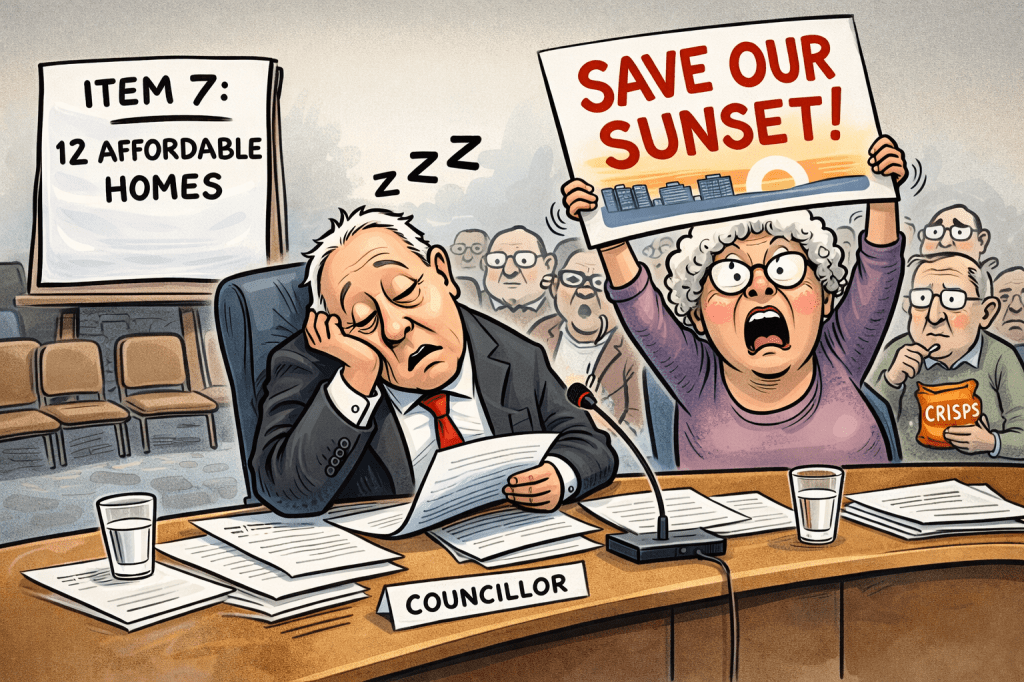
    Instead, I’ve watched meetings where the Chairwoman nodded off mid-way through a major application. Where councillors fumbled through speeches they clearly didn’t write — usually provided by the local pressure group. Where “debate” means repeating the same handful of buzzwords: overdevelopment, traffic, flooding, character. Always character.

    The audience is often made up of retirees who’ve been to more planning meetings than the committee itself. They know when to tut. They know when to mutter “disgraceful.” Some bring sandwiches.

    Applications are “called in” for no better reason than local outrage. Evidence is treated with suspicion. Emotions run high. Facebook posts are read out as if they carried legal weight.

    And too often, officers’ reports — which are detailed, balanced, and policy-driven — are ignored in favour of a speech from someone who once saw a hedgehog on the site.

    This is not democratic planning. It’s crowd management in a cold room.


    Responsive, Not Representative

    The uncomfortable truth is that committees are not genuinely representative. They are responsive — to the noisiest campaigners, the angriest objectors, the most politically inconvenient headlines.

    Public objections are a vital part of the process, of course. But we’ve reached a point where planning decisions hinge less on material considerations and more on who has the loudest WhatsApp group.

    It’s a system that rewards drama over detail.

    Councillors are under pressure. Many are doing their best. But when fear of political fallout trumps policy, and when decisions are based on heat rather than light, then we’ve stopped making planning decisions — we’re just managing optics.


    There Is Another Way

    I’ve seen a different model. I’ve worked with the Development Corporation in Tees Valley, where decisions are taken by appointed officers — often consultants — under delegated authority. No committees. No political theatre. No ritualistic objections.

    Decisions are taken within eight weeks. They are evidence-based, policy-led, and thoroughly documented. You may not always agree with the outcome, but you can follow the reasoning. You can trace the logic.

    It works. Because it’s designed to work.

    It’s not revolutionary. It’s just… planning.


    What’s the Point of Committees, Then?

    That’s the question we need to ask — bluntly.

    If committees don’t consistently improve decisions, or speed them up, or make them fairer, what exactly are they adding?

    We’re clinging to a format that’s visibly buckling. A structure that belongs to an age before online engagement, before plan-led systems, before clear policy frameworks. We treat committee meetings as sacred, even as they deliver delays, reversals, and the kind of decisions that make judicial review lawyers rub their hands together.


    What Might a Hybrid Model Look Like?

    This isn’t about removing elected oversight — it’s about making it work.

    A reformed system might mean:

    • Most decisions delegated to officers under clear policy frameworks.
    • Panels of trained decision-makers, with members held to basic standards of competence.
    • Clear protocols for engagement, scrutiny, and transparency — without the theatre.

    If you insist on “localism,” at least make it literate.

    We wouldn’t allow a councillor to vote on a licensing board without training. Yet we let them determine multi-million-pound developments based on what they saw during a site visit through the bus window.


    Closing Thoughts

    I’ve lost count of the meetings that ended in confusion, anger, or absurd compromise. I’ve heard refusals justified on grounds so flimsy they collapsed at appeal before the ink was dry. I’ve watched professional advice tossed aside because someone feared their election leaflet.

    This isn’t democracy. It’s performance. Performance with consequences.

    So let’s be honest: if we designed a planning system from scratch tomorrow, would anyone seriously propose… this?

    It’s time to stop pretending planning committees, in their current form, are working. We can preserve democratic principles without preserving pantomime.

    And we owe it to everyone — applicants, residents, and planners alike — to make decisions that are better than this.

  • Brief Encounters: A Planner’s Homage to the Barristers Who Save – and Occasionally Sink – Us

    Planning barristers are a bit like the espresso shot in your professional coffee — intense, essential, and likely to keep you awake at night.

    They arrive, often with minimal warning, to skim-read the case file you’ve been tenderly nursing for six months, and somehow pronounce it “straightforward”. They cross-examine ecologists with the delicacy of a raptor. They conjure statutory interpretation from thin air. They quote paragraph 174(b) of the NPPF as if it were poetry. And, with terrifying regularity, they are right.

    This is, of course, maddening.

    And yet, we remain in awe.

    This article is a small, tongue-in-cheek tribute to that rare breed of legal professional who can summarise an entire Local Plan, pick holes in your policy reasoning, and still find time to demand a sandwich of “appropriate gravitas” during the lunch break.

    It’s also an introduction to a new book – a farcical, affectionate, and occasionally savage tale set in the world of planning law. A world many of us know, and some of us would rather forget.

    But first, let us raise a rhetorical glass to the planning barristers who make our lives both easier and infinitely more complicated.


    The File Whisperers

    There is something faintly wizard-like about the way a seasoned KC can materialise at a public inquiry and, within hours, distil hundreds of pages of environmental assessments, transport modelling, and emotional representations into a coherent legal argument.

    You’ve been wrestling with the biodiversity net gain matrix for weeks. They glance at it and say, “Ah, we’ll run that as a point on mitigation hierarchy. Cross-examination at 11:10.”

    You flinch, blink, and briefly contemplate moving to the leisure team.

    To watch a barrister dissect a policy conflict in real time is to witness both brilliance and bloodsport. It’s thrilling. It’s awful. It’s often exactly what’s needed. They are, in their purest form, the oracles of the planning system – if the oracles had strong opinions about visibility splays.


    Love, Hate, Law

    The relationship between planning officers and planning counsel is complicated. You adore their clarity and loathe their condescension. You need their insight and dread their questions. They are, in short, the consultants you didn’t choose but are now legally and emotionally married to for the duration of the appeal.

    There are the moments of genuine gratitude — the night-before bundling session where your silk calmly rewrites your week’s worth of witness notes and says, “There. Now it sounds as though someone meant it.”

    There are also the darker hours — the times your counsel casually suggests that your enforcement case might be “optimistic”, or that your housing land supply figures appear to have been “assembled by optimistic squirrels”.

    They don’t mean to wound. It’s just that many have spent twenty years in a profession where pointing out someone else’s failure is considered polite conversation.

    And then, of course, there are the moments you wish — viscerally, vengefully — that the other side hadn’t instructed counsel. The kind of inquiry where a seemingly benign landscape architect is reduced to tears under cross-examination. The kind where a single KC manages to convince the Inspector that a caravan park is, in fact, a form of heritage-led regeneration.

    But the truth is, when it all goes wrong, the barrister is often the one standing in front of the train. Even if they’ve first reminded you that the train is your fault.


    Introducing Roddy Bickerstaff KC

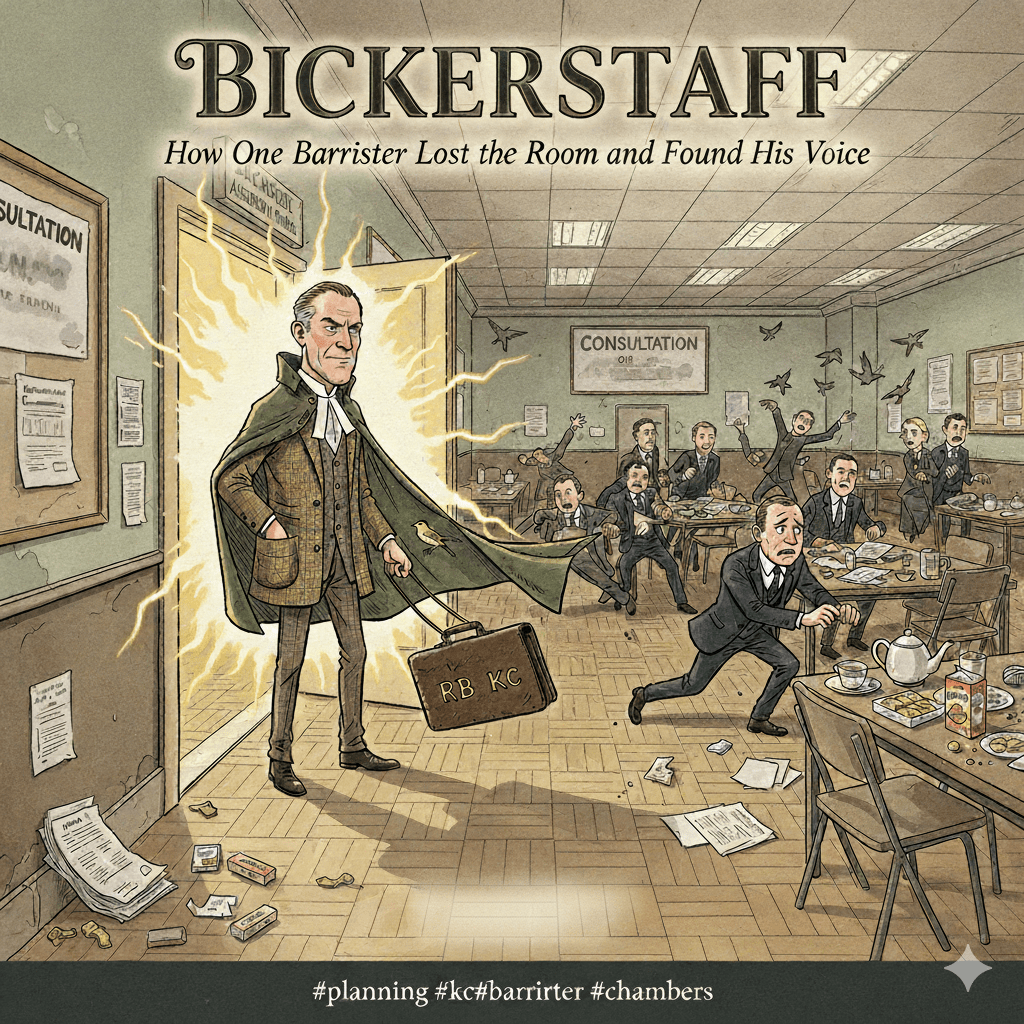
    It is into this absurd and strangely noble world that we drop Roddy Bickerstaff KC — the star of Bickerstaff: How One Barrister Lost the Room and Found His Voice.

    Roddy is a creature of courtroom ritual, all school tie and contempt. He thrives on superiority, despises snacks, and believes most junior barristers to be a regrettable administrative error.

    At least, until he forgets to mute his microphone.

    The book opens at a planning inquiry in Bakewell, where Roddy arrives with all the subtlety of a thunderstorm. He belittles his junior, insults the witnesses, and delivers a scathing commentary on the very process that employs him – unaware he’s doing it live. To the nation….on the red button.

    The consequences unravel across chambers, social media, and the entire legal profession.

    At the heart of the story is a relationship familiar to anyone in the profession: the barrister and the junior. Or in this case, the tyrant and the intern. What begins as a satire on arrogance slowly shifts into something more surprising — a meditation on professional redemption, the shifting power of truth, and the quiet dignity of those who spend their careers being overlooked.

    And yes, there are skylarks.


    An Extract: Thunderclap in Tweed

    To give a flavour, here is a paragraph from Chapter One – the infamous Bakewell inquiry. This is how Roddy arrives:

    “Roddy Bickerstaff KC did not so much enter the Assembly Rooms as impose his will upon them. He appeared in the doorway like a thunderclap in tweed — all shoulder-rolling superiority and the swish of expensive fabric, a Barbour cloak of invincibility half-cocked like a matador’s cape. His briefcase — real leather, obviously — trailed behind him as if cowed by its own importance.

    He surveyed the room. A shoddy theatre of municipal compromise: scuffed parquet, weak tea, and wall-mounted desperation. The Bakewell Assembly Rooms were where laminated consultation boards came to die. Roddy’s lip curled with affectionate disgust.

    “Coffee,” he barked, to no one in particular.

    Somewhere behind him, junior barristers scattered like startled starlings. Kallum O’Keefe — his designated pack mule for the inquiry — peeled away, heading for the refreshments table with the downtrodden zeal of a condemned man fetching his own blindfold.”

    It goes downhill (for Roddy) and uphill (for the reader) from there.


    What’s It Really About?

    While Bickerstaff is a comedy — sometimes farce, sometimes satire — it’s ultimately a book about voice.

    Who gets to speak? Who is heard? And what happens when the silent people finally find their audience?

    It’s about the power imbalance between silks and juniors, consultants and case officers, planning committees and the people who prepare the minutes.

    It’s also, unashamedly, about the joy and terror of the public inquiry. That glorious circus of opinion, policy, and shortbread. The book loves it as much as it mocks it.

    There are no villains in this story. Only professionals – tired, principled, flawed – trying to do their jobs under the flickering light of scrutiny. Some rise. Some fall. All are recognisable.


    Who Should Read It

    If you’ve ever briefed a barrister and then had to apologise for the size of the evidence folder – this is for you.

    If you’ve ever winced at a late-night email about the phrasing of a condition – this is for you.

    If you’ve ever sat in a draughty hall and wondered how this became your career – then welcome. You’re among friends.

    It’s for the legal profession. The planning profession. The underpaid, the over-prepared, and the quietly brilliant.

    And yes, it’s especially for the juniors.


    Final Submission

    Bickerstaff: How One Barrister Lost the Room and Found His Voice is available now. It contains Latin, sarcasm, hedgerows, and the finest fictional inquiry Bakewell has ever seen.

    If you’ve ever wanted a satirical backstage pass to the world of planning law — this is it.

    Inspector, I rest my case.

    #planning #kc #barrister #chambers