I’ve sat through too many planning committees to retain any romantic notions about what they are. Or what they were ever supposed to be.
The theory, of course, is noble. That planning committees are a bastion of local democracy. That they offer a transparent space for difficult decisions. That they balance technical advice with local knowledge.
But in practice? They are often pantomime. Noisy, chaotic, slow, and politically fragile. And in their current form, they do not work.
What Committees Are Supposed to Be
Let’s give them their due — on paper, committees are meant to be the democratic cornerstone of the system. A public platform where local councillors weigh officer advice, planning policy, and public opinion. The idea is that elected members provide balance — community insight, democratic legitimacy, a wider perspective.
But I can count on one hand the number of times I’ve seen a committee genuinely function like that.
What Actually Happens
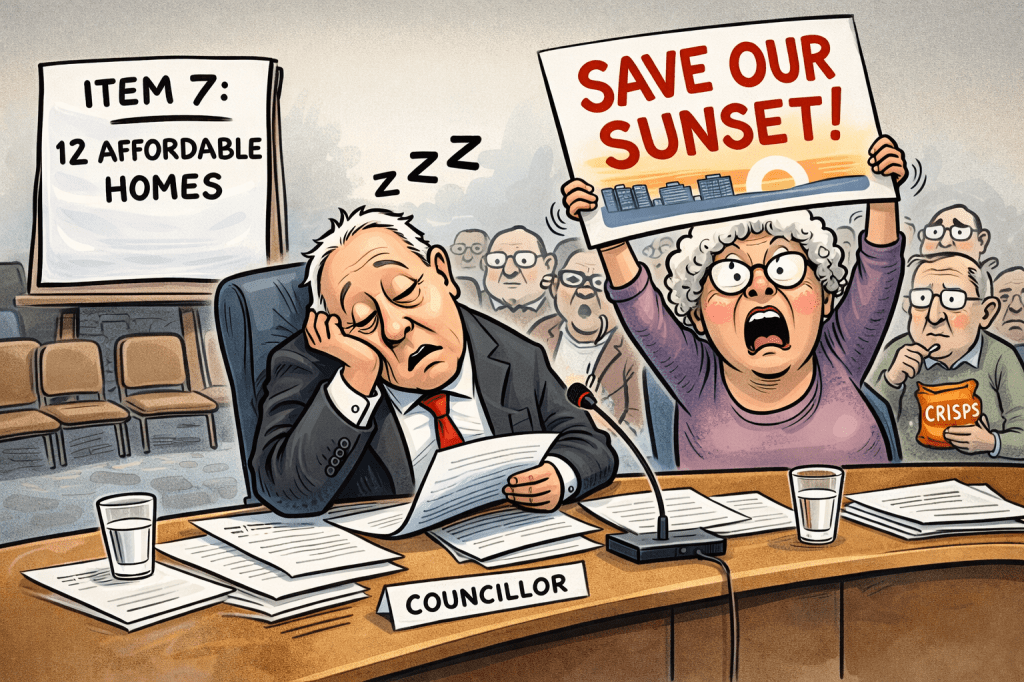
Instead, I’ve watched meetings where the Chairwoman nodded off mid-way through a major application. Where councillors fumbled through speeches they clearly didn’t write — usually provided by the local pressure group. Where “debate” means repeating the same handful of buzzwords: overdevelopment, traffic, flooding, character. Always character.
The audience is often made up of retirees who’ve been to more planning meetings than the committee itself. They know when to tut. They know when to mutter “disgraceful.” Some bring sandwiches.
Applications are “called in” for no better reason than local outrage. Evidence is treated with suspicion. Emotions run high. Facebook posts are read out as if they carried legal weight.
And too often, officers’ reports — which are detailed, balanced, and policy-driven — are ignored in favour of a speech from someone who once saw a hedgehog on the site.
This is not democratic planning. It’s crowd management in a cold room.
Responsive, Not Representative
The uncomfortable truth is that committees are not genuinely representative. They are responsive — to the noisiest campaigners, the angriest objectors, the most politically inconvenient headlines.
Public objections are a vital part of the process, of course. But we’ve reached a point where planning decisions hinge less on material considerations and more on who has the loudest WhatsApp group.
It’s a system that rewards drama over detail.
Councillors are under pressure. Many are doing their best. But when fear of political fallout trumps policy, and when decisions are based on heat rather than light, then we’ve stopped making planning decisions — we’re just managing optics.
There Is Another Way
I’ve seen a different model. I’ve worked with the Development Corporation in Tees Valley, where decisions are taken by appointed officers — often consultants — under delegated authority. No committees. No political theatre. No ritualistic objections.
Decisions are taken within eight weeks. They are evidence-based, policy-led, and thoroughly documented. You may not always agree with the outcome, but you can follow the reasoning. You can trace the logic.
It works. Because it’s designed to work.
It’s not revolutionary. It’s just… planning.
What’s the Point of Committees, Then?
That’s the question we need to ask — bluntly.
If committees don’t consistently improve decisions, or speed them up, or make them fairer, what exactly are they adding?
We’re clinging to a format that’s visibly buckling. A structure that belongs to an age before online engagement, before plan-led systems, before clear policy frameworks. We treat committee meetings as sacred, even as they deliver delays, reversals, and the kind of decisions that make judicial review lawyers rub their hands together.
What Might a Hybrid Model Look Like?
This isn’t about removing elected oversight — it’s about making it work.
A reformed system might mean:
- Most decisions delegated to officers under clear policy frameworks.
- Panels of trained decision-makers, with members held to basic standards of competence.
- Clear protocols for engagement, scrutiny, and transparency — without the theatre.
If you insist on “localism,” at least make it literate.
We wouldn’t allow a councillor to vote on a licensing board without training. Yet we let them determine multi-million-pound developments based on what they saw during a site visit through the bus window.
Closing Thoughts
I’ve lost count of the meetings that ended in confusion, anger, or absurd compromise. I’ve heard refusals justified on grounds so flimsy they collapsed at appeal before the ink was dry. I’ve watched professional advice tossed aside because someone feared their election leaflet.
This isn’t democracy. It’s performance. Performance with consequences.
So let’s be honest: if we designed a planning system from scratch tomorrow, would anyone seriously propose… this?
It’s time to stop pretending planning committees, in their current form, are working. We can preserve democratic principles without preserving pantomime.
And we owe it to everyone — applicants, residents, and planners alike — to make decisions that are better than this.
 steve hesmondhalgh