Tag: planners

  • Green Belt: The Sacred Cow Grazing on Our Planning Future

    If land were religion, the Green Belt would be its high priest. Revered. Untouchable. Endlessly invoked in speeches and consultations as the last bulwark between concrete and countryside. Say the phrase “Green Belt release” in a public meeting and you can watch elected members age visibly before your eyes.
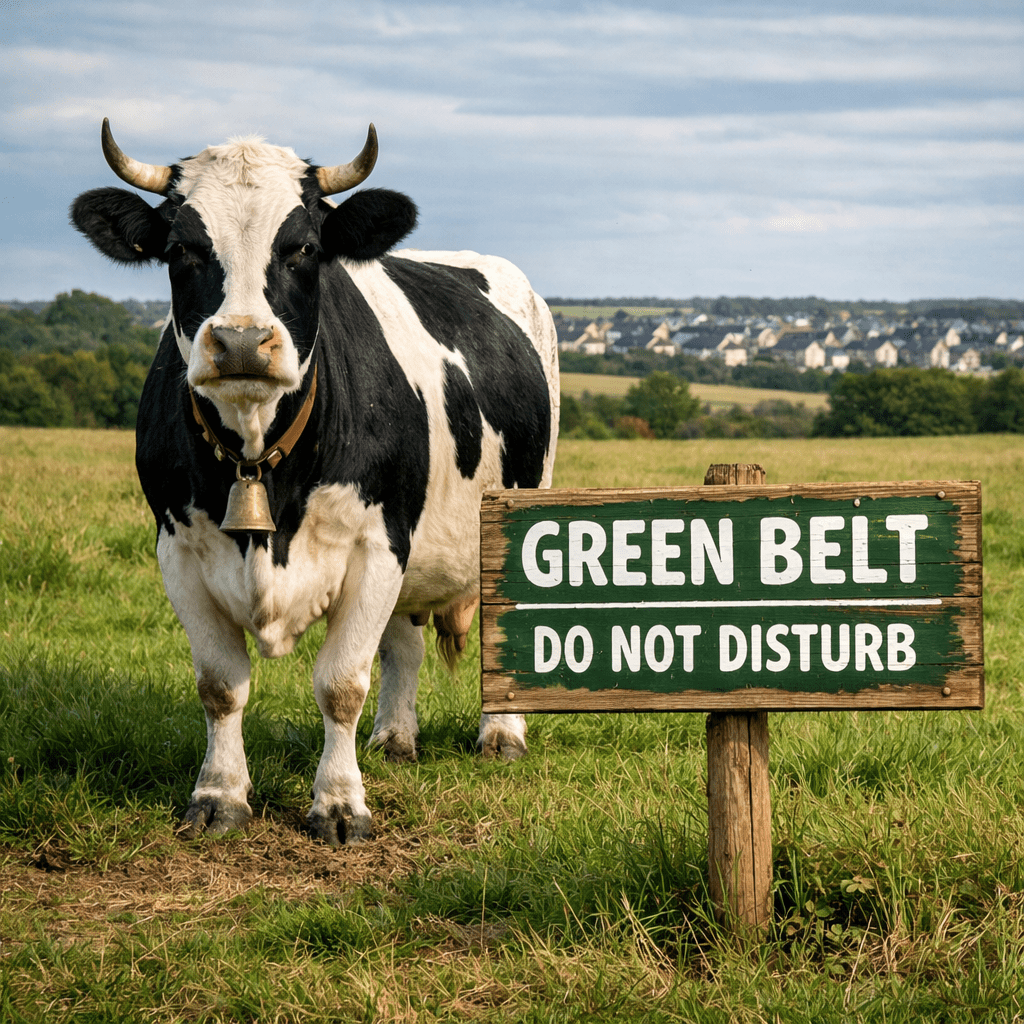
    But beneath the reverence lies a policy creaking at the joints, weighed down by decades of confused thinking, public misunderstanding, and political timidity. The question is no longer whether the Green Belt needs review — it’s whether we’re capable of admitting it.


    What Was the Green Belt For?

    The Green Belt wasn’t designed to be a beauty contest or a landscape designation. It wasn’t about protecting England’s green and pleasant land in general. It was a policy tool with clear strategic aims, introduced after the Second World War to:

    • Prevent urban sprawl
    • Protect the setting of towns and cities
    • Avoid the merging of neighbouring settlements
    • Encourage urban regeneration by containing development within existing areas

    It was, in theory, a bold and rational spatial device — a ring of restraint around major urban areas, shaping growth inward rather than outward.

    It wasn’t a promise that every green field would be protected. Nor was it based on ecological value, biodiversity, or landscape character. Yet over time, these misconceptions have grown roots of their own.


    Is It Still Doing That?

    In some places, yes. But in many others, the Green Belt is now doing something else entirely — and not always for the better.

    Rather than stopping sprawl, it often pushes it further out. Development leapfrogs the belt, landing in towns and villages beyond it. The result? Long commutes, car dependency, and splintered communities. Meanwhile, the inner edges of cities — close to jobs, services, and public transport — remain frozen, even where land is of low landscape or ecological value.

    The idea of “urban containment” works best when there’s a strong policy to build up, not just out. But the pressure on land and the scarcity of brownfield sites in many areas mean that containment has turned into constraint. And constraint, without direction, creates sprawl by stealth.

    It’s also worth saying — quietly, because this tends to ruin dinner parties — that not all Green Belt land is lovely. Much of it is unremarkable: intensively farmed, inaccessible, ecologically poor. You can’t walk through it, picnic in it, or enjoy it from a train window. It is “green” in planning terms only — and sometimes not even that.


    Why Don’t We Reform or Remove It?

    Because, quite simply, it is politically radioactive.

    Any attempt to review or redefine the Green Belt is met with howls of betrayal. National politicians know this, and local politicians feel it — in their inboxes, on doorsteps, at public meetings. Defending the Green Belt is electorally safe. Challenging it is not.

    Never mind that many people conflate Green Belt with “all green fields.” Or that they assume it’s about beauty, when it’s about boundaries. These myths are now baked into the public consciousness — and they’re not easily undone in a planning policy footnote.

    The result? Endless tinkering. “Exceptional circumstances” here. Strategic swaps there. Quiet incursions through local plans, but no national reckoning. We’re rearranging the deckchairs while pretending the ship is unsinkable.


    The Problem With Tweaks

    The idea of treating the Green Belt as permanent — as something beyond review — is oddly unplanning-like. Everything else in planning is negotiable. Everything else can be tested, balanced, consulted on. But the Green Belt is often treated as dogma, not policy.

    And when we do tweak it, we do so under immense pressure. Sites are carved out through bruising local plan examinations or court battles. The burden of proof is heavy, the politics even heavier. So instead of a rational, national conversation about growth, we end up with a patchwork of exceptions — each one fought for like a planning war of attrition.

    Meanwhile, homes are still needed. Infrastructure still ages. And policy limps on.


    What Might a Rational Policy Look Like?

    Start with a clean sheet. Ask: where should growth go, based on need, sustainability, connectivity, and environmental value?

    Some areas of Green Belt might still be essential — for setting, separation, or containment. But others, frankly, are candidates for review. And not because we want to pave paradise. Because we want to build homes in places that make sense.

    We should be protecting landscape, nature, and accessibility — not lines drawn in 1955 on the basis of how far a city had spread post-war. We should stop pretending that all Green Belt is sacred, and instead start treating it like the policy tool it was meant to be: strategic, revisable, and responsive.


    Conclusion: The Sacred Cow Needs a Vet

    The Green Belt served its time. It brought discipline to post-war growth. It helped shape cities and protect countryside. But we are now using it to fight a very different battle — against a housing crisis, against climate goals, against economic inequality.

    And in that battle, the Green Belt is not always on the right side.

    Yet despite the urgency, too often the loudest voices in the room belong not to planners, nor to those affected by housing need, but to local chapters of the CPRE — well-meaning, undoubtedly passionate, but often unqualified and unaccountable. Many worship at the altar of the Green Belt with a fervour that borders on the devotional. Their objections are predictable, relentless, and almost always against change.

    The question is: should we really allow such groups, however earnest, to shape national planning outcomes? Is it right that housing delivery, urban sustainability, and spatial policy should be hostage to those who view any development as a threat, and who see Green Belt as sacred ground, not strategic tool?

    It’s not heresy to ask. It’s just planning.

    Let’s stop treating the Green Belt like a relic beyond question. Because if we can’t even ask whether this tool is still fit for purpose, we’ve already given up on planning as a profession — and on homes as a right, not a privilege.
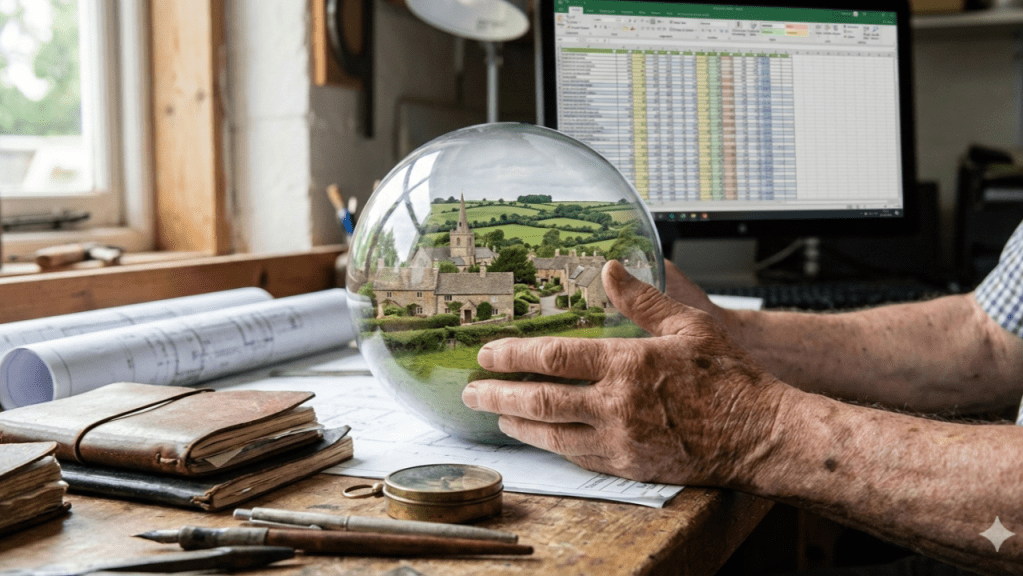
  • The Vanishing Art of Knowing Things: Whatever Happened to the All-Round Planner?

    A reflection on memory, marbles, and the slow erosion of planning as a craft.

    I remember attending a parish council meeting with the Director, back in the halcyon days when I still had full control of my cognitive filing cabinet. I’d worked that patch for five years. I knew the landowners, the lay-bys, the footpaths, and which councillor had a particular allergy to external cladding.

    It was one of those moments we rarely get anymore: walking into a room, and not only knowing what the current application said, but what the last one said, and the one before that. Knowing the objections raised in 2013, who raised them, and what the Chair of Planning had muttered about it under his breath while pretending to read the officer’s report.

    The Director came to observe. I came to perform. Questions flew – policy references, procedural nuance, historical context. I answered them all, not with bombast, but with certainty. It was like being a GP who could diagnose the condition, recall treating the patient’s brother three years ago, and still had time to ask how the allotment was doing.

    And the parish councillors? Well, they were stunned. Not because I dazzled them with jargon – but because I understood. The legislation. The context. The village. The planning history. The people.

    Back then, my brain was like a clean white plate with a few well-placed marbles. Each marble had room to roll – purposefully, elegantly. These days, of course, the plate is a riot. Marbles everywhere. A dozen daily updates to the NPPF, half-heard briefings on nutrient neutrality, a flurry of Teams invites from five overlapping departments, and a planning portal that occasionally seems to delete applications just for the thrill of it. Every new marble knocks another one off the edge – usually something important, like what a “conservation area” actually is.

    But here’s the thing. I can cope. I had twenty years of plate space before the marble tsunami arrived. I had time to learn.


    Why Aren’t Junior Planners Getting There?

    And this is the part that’s been needling me.

    The young planners I work with (on both sides) – bright, sharp, willing – don’t get to that moment of clarity. They don’t get five years on a patch. They don’t get time to dig in, reflect, or ask “why?”. They know how to process an application, sure. They understand the system that’s been handed to them. But the broader context? The craft? The quiet confidence that comes from knowing place, not just policy? That’s vanishing.

    Why?

    Because we’ve built a system that rewards task-completion, not understanding. Specialisation is prized over synthesis. We train planners to handle their bit, then pass the parcel. Biodiversity? That’s the ecologist’s job. Design? Send it to urban design. Public comments? Filter, summarise, move on. And so the planner becomes a relay runner – sprinting with a small section of the baton, rarely seeing the full race.

    And we wonder why decisions are inconsistent. Why officers are burned out. Why community trust is low. Why we churn staff faster than a poorly mixed concrete pour.


    The Lost Joy of Professional Mastery

    Here’s a truth we don’t say out loud: it’s immensely satisfying to be good at this job. Not competent. Good. To know your policy base and your patch. To stand in front of a committee or a community and feel that grounded confidence. That only comes with time, and more importantly – with opportunity.

    It doesn’t come from watching a webinar. It comes from watching a planning committee over five years and noticing which councillor is obsessed with traffic, which one trusts officers implicitly, and which one once got bitten by a bat and now distrusts all ecological reports on principle.

    It comes from mentoring. From the thousand informal conversations in the car park or the lunchroom, where you realise that planning isn’t just about development – it’s about place. It’s about people.

    And crucially – it comes from not being overloaded to the point of paralysis.


    Can We Fix It? (Not With a 3-Month Graduate Scheme)

    I don’t want this to be another nostalgic moan from someone who remembers when development management was called “development control” and no one had discovered “deliverability” as a weaponised word.

    But I do want us to ask: are we raising planners, or processing officers?

    Are we giving them the time, the space, and the encouragement to become proper planners – the kind who could walk into a village hall and remember what happened in 2009, and why the hedgerow mattered?

    Here’s a radical suggestion:

    • Let juniors stay on patches for more than six minutes.
    • Encourage them to read old files – not because they have to, but because they want to understand.
    • Pair them with old warhorses who’ve been through three local plans, one reorganisation and a mysterious incident involving an over-zealous parish clerk and a hand-painted footpath sign.
    • Celebrate generalists. Honour memory. Stop acting like the only kind of professional is a specialist.

    Let the Marbles Settle

    We need more planners who know why they’re doing what they’re doing – not just what checkboxes to tick.

    Because without that, we’re not really planners at all. We’re administrators of policy PDFs.

    And one day, when the last generalist retires, we’ll realise we’ve lost something that can’t be replaced with a template.

    So here’s to the plate. To the marbles. And to making space again – for memory, meaning, and the joy of being bloody good at what you do.

    Footnote (for the keen, the curious, or the currently coasting):

    It’s only fair to admit that when I started out, I was hopeless.

    After five years at university – the majority of which was spent at the bar (and not the useful legal kind) – I arrived in my first planning job with the professional focus of a houseplant. I hadn’t read a single policy document. I certainly hadn’t read the GDO (as it was quaintly called then – no reference to “permitted development rights” back in those days). I thought “Article 4” was possibly a treaty.

    But I was lucky. I had a Chief Planner who told me, quite bluntly, to go off and read. I had a colleague who understood time management and could spot nonsense at fifty paces. And I had the time – and just enough self-awareness – to realise I needed to put in the work. I also had a newly born son (who is now mid 30’s), and the creeping realisation that if I didn’t get my act together, I’d be explaining the difference between outline and full permission while stacking shelves at night.

    So I made the decision: to stop bluffing, start learning, and get good at the job.

    And that’s what I’d say now to anyone at the start of their planning career: look around the room. Then quietly resolve to get better than every single person in it.

    Not in a smug way. Not in a political way. Just in the quiet, competent, bloody-useful kind of way.

    Be the person others come to for advice. Be the one who remembers, who understands, who joins the dots. And then one day – probably without even noticing – you’ll become the planner people trust.

    And if you do that… you might just start enjoying this job more than you expected.