Planning barristers are a bit like the espresso shot in your professional coffee — intense, essential, and likely to keep you awake at night.
They arrive, often with minimal warning, to skim-read the case file you’ve been tenderly nursing for six months, and somehow pronounce it “straightforward”. They cross-examine ecologists with the delicacy of a raptor. They conjure statutory interpretation from thin air. They quote paragraph 174(b) of the NPPF as if it were poetry. And, with terrifying regularity, they are right.
This is, of course, maddening.
And yet, we remain in awe.
This article is a small, tongue-in-cheek tribute to that rare breed of legal professional who can summarise an entire Local Plan, pick holes in your policy reasoning, and still find time to demand a sandwich of “appropriate gravitas” during the lunch break.
It’s also an introduction to a new book – a farcical, affectionate, and occasionally savage tale set in the world of planning law. A world many of us know, and some of us would rather forget.
But first, let us raise a rhetorical glass to the planning barristers who make our lives both easier and infinitely more complicated.
The File Whisperers
There is something faintly wizard-like about the way a seasoned KC can materialise at a public inquiry and, within hours, distil hundreds of pages of environmental assessments, transport modelling, and emotional representations into a coherent legal argument.
You’ve been wrestling with the biodiversity net gain matrix for weeks. They glance at it and say, “Ah, we’ll run that as a point on mitigation hierarchy. Cross-examination at 11:10.”
You flinch, blink, and briefly contemplate moving to the leisure team.
To watch a barrister dissect a policy conflict in real time is to witness both brilliance and bloodsport. It’s thrilling. It’s awful. It’s often exactly what’s needed. They are, in their purest form, the oracles of the planning system – if the oracles had strong opinions about visibility splays.
Love, Hate, Law
The relationship between planning officers and planning counsel is complicated. You adore their clarity and loathe their condescension. You need their insight and dread their questions. They are, in short, the consultants you didn’t choose but are now legally and emotionally married to for the duration of the appeal.
There are the moments of genuine gratitude — the night-before bundling session where your silk calmly rewrites your week’s worth of witness notes and says, “There. Now it sounds as though someone meant it.”
There are also the darker hours — the times your counsel casually suggests that your enforcement case might be “optimistic”, or that your housing land supply figures appear to have been “assembled by optimistic squirrels”.
They don’t mean to wound. It’s just that many have spent twenty years in a profession where pointing out someone else’s failure is considered polite conversation.
And then, of course, there are the moments you wish — viscerally, vengefully — that the other side hadn’t instructed counsel. The kind of inquiry where a seemingly benign landscape architect is reduced to tears under cross-examination. The kind where a single KC manages to convince the Inspector that a caravan park is, in fact, a form of heritage-led regeneration.
But the truth is, when it all goes wrong, the barrister is often the one standing in front of the train. Even if they’ve first reminded you that the train is your fault.
Introducing Roddy Bickerstaff KC
It is into this absurd and strangely noble world that we drop Roddy Bickerstaff KC — the star of Bickerstaff: How One Barrister Lost the Room and Found His Voice.
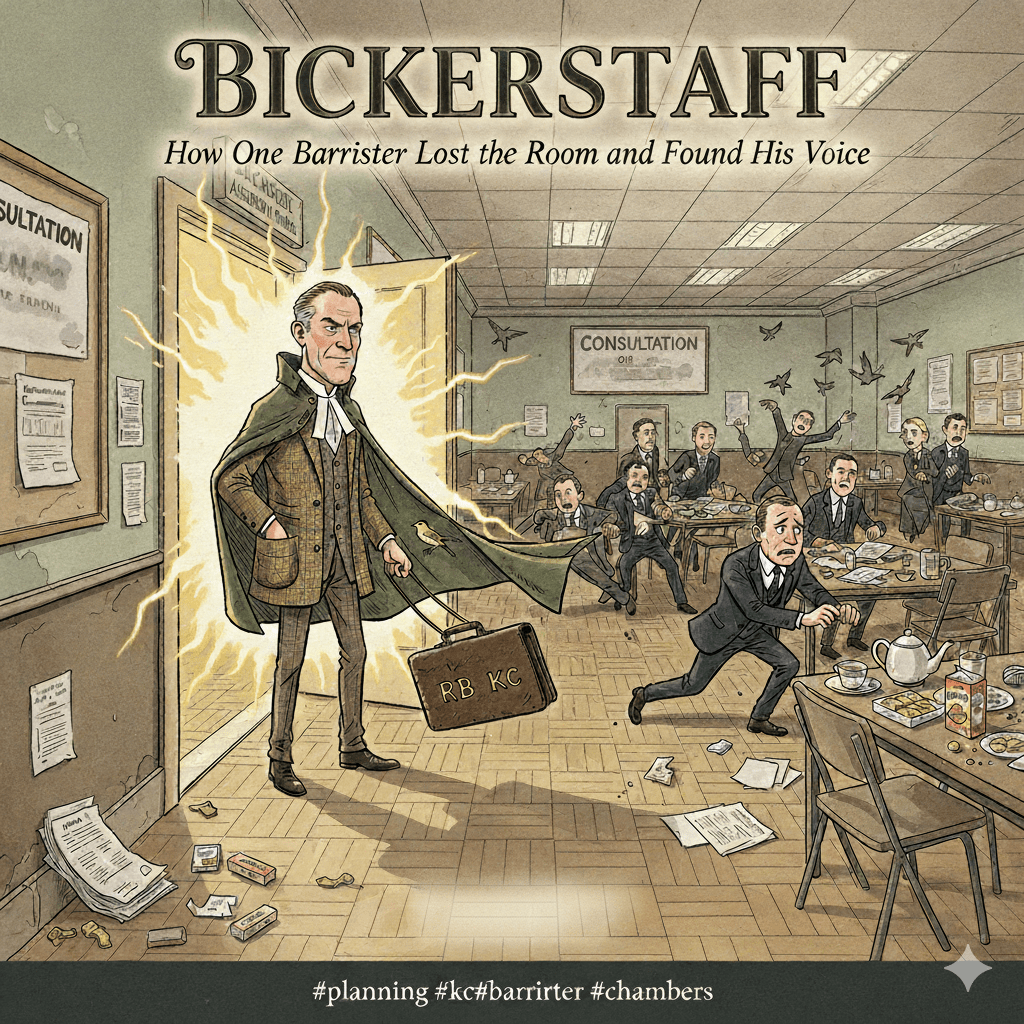
Roddy is a creature of courtroom ritual, all school tie and contempt. He thrives on superiority, despises snacks, and believes most junior barristers to be a regrettable administrative error.
At least, until he forgets to mute his microphone.
The book opens at a planning inquiry in Bakewell, where Roddy arrives with all the subtlety of a thunderstorm. He belittles his junior, insults the witnesses, and delivers a scathing commentary on the very process that employs him – unaware he’s doing it live. To the nation….on the red button.
The consequences unravel across chambers, social media, and the entire legal profession.
At the heart of the story is a relationship familiar to anyone in the profession: the barrister and the junior. Or in this case, the tyrant and the intern. What begins as a satire on arrogance slowly shifts into something more surprising — a meditation on professional redemption, the shifting power of truth, and the quiet dignity of those who spend their careers being overlooked.
And yes, there are skylarks.
An Extract: Thunderclap in Tweed
To give a flavour, here is a paragraph from Chapter One – the infamous Bakewell inquiry. This is how Roddy arrives:
“Roddy Bickerstaff KC did not so much enter the Assembly Rooms as impose his will upon them. He appeared in the doorway like a thunderclap in tweed — all shoulder-rolling superiority and the swish of expensive fabric, a Barbour cloak of invincibility half-cocked like a matador’s cape. His briefcase — real leather, obviously — trailed behind him as if cowed by its own importance.
He surveyed the room. A shoddy theatre of municipal compromise: scuffed parquet, weak tea, and wall-mounted desperation. The Bakewell Assembly Rooms were where laminated consultation boards came to die. Roddy’s lip curled with affectionate disgust.
“Coffee,” he barked, to no one in particular.
Somewhere behind him, junior barristers scattered like startled starlings. Kallum O’Keefe — his designated pack mule for the inquiry — peeled away, heading for the refreshments table with the downtrodden zeal of a condemned man fetching his own blindfold.”
It goes downhill (for Roddy) and uphill (for the reader) from there.
What’s It Really About?
While Bickerstaff is a comedy — sometimes farce, sometimes satire — it’s ultimately a book about voice.
Who gets to speak? Who is heard? And what happens when the silent people finally find their audience?
It’s about the power imbalance between silks and juniors, consultants and case officers, planning committees and the people who prepare the minutes.
It’s also, unashamedly, about the joy and terror of the public inquiry. That glorious circus of opinion, policy, and shortbread. The book loves it as much as it mocks it.
There are no villains in this story. Only professionals – tired, principled, flawed – trying to do their jobs under the flickering light of scrutiny. Some rise. Some fall. All are recognisable.
Who Should Read It
If you’ve ever briefed a barrister and then had to apologise for the size of the evidence folder – this is for you.
If you’ve ever winced at a late-night email about the phrasing of a condition – this is for you.
If you’ve ever sat in a draughty hall and wondered how this became your career – then welcome. You’re among friends.
It’s for the legal profession. The planning profession. The underpaid, the over-prepared, and the quietly brilliant.
And yes, it’s especially for the juniors.
Final Submission
Bickerstaff: How One Barrister Lost the Room and Found His Voice is available now. It contains Latin, sarcasm, hedgerows, and the finest fictional inquiry Bakewell has ever seen.
If you’ve ever wanted a satirical backstage pass to the world of planning law — this is it.
Inspector, I rest my case.
#planning #kc #barrister #chambers
 steve hesmondhalgh