Author: stevehes

  • Green Belt: The Sacred Cow Grazing on Our Planning Future

    If land were religion, the Green Belt would be its high priest. Revered. Untouchable. Endlessly invoked in speeches and consultations as the last bulwark between concrete and countryside. Say the phrase “Green Belt release” in a public meeting and you can watch elected members age visibly before your eyes.

    But beneath the reverence lies a policy creaking at the joints, weighed down by decades of confused thinking, public misunderstanding, and political timidity. The question is no longer whether the Green Belt needs review — it’s whether we’re capable of admitting it.


    What Was the Green Belt For?

    The Green Belt wasn’t designed to be a beauty contest or a landscape designation. It wasn’t about protecting England’s green and pleasant land in general. It was a policy tool with clear strategic aims, introduced after the Second World War to:

    • Prevent urban sprawl
    • Protect the setting of towns and cities
    • Avoid the merging of neighbouring settlements
    • Encourage urban regeneration by containing development within existing areas

    It was, in theory, a bold and rational spatial device — a ring of restraint around major urban areas, shaping growth inward rather than outward.

    It wasn’t a promise that every green field would be protected. Nor was it based on ecological value, biodiversity, or landscape character. Yet over time, these misconceptions have grown roots of their own.


    Is It Still Doing That?

    In some places, yes. But in many others, the Green Belt is now doing something else entirely — and not always for the better.

    Rather than stopping sprawl, it often pushes it further out. Development leapfrogs the belt, landing in towns and villages beyond it. The result? Long commutes, car dependency, and splintered communities. Meanwhile, the inner edges of cities — close to jobs, services, and public transport — remain frozen, even where land is of low landscape or ecological value.

    The idea of “urban containment” works best when there’s a strong policy to build up, not just out. But the pressure on land and the scarcity of brownfield sites in many areas mean that containment has turned into constraint. And constraint, without direction, creates sprawl by stealth.

    It’s also worth saying — quietly, because this tends to ruin dinner parties — that not all Green Belt land is lovely. Much of it is unremarkable: intensively farmed, inaccessible, ecologically poor. You can’t walk through it, picnic in it, or enjoy it from a train window. It is “green” in planning terms only — and sometimes not even that.


    Why Don’t We Reform or Remove It?

    Because, quite simply, it is politically radioactive.

    Any attempt to review or redefine the Green Belt is met with howls of betrayal. National politicians know this, and local politicians feel it — in their inboxes, on doorsteps, at public meetings. Defending the Green Belt is electorally safe. Challenging it is not.

    Never mind that many people conflate Green Belt with “all green fields.” Or that they assume it’s about beauty, when it’s about boundaries. These myths are now baked into the public consciousness — and they’re not easily undone in a planning policy footnote.

    The result? Endless tinkering. “Exceptional circumstances” here. Strategic swaps there. Quiet incursions through local plans, but no national reckoning. We’re rearranging the deckchairs while pretending the ship is unsinkable.


    The Problem With Tweaks

    The idea of treating the Green Belt as permanent — as something beyond review — is oddly unplanning-like. Everything else in planning is negotiable. Everything else can be tested, balanced, consulted on. But the Green Belt is often treated as dogma, not policy.

    And when we do tweak it, we do so under immense pressure. Sites are carved out through bruising local plan examinations or court battles. The burden of proof is heavy, the politics even heavier. So instead of a rational, national conversation about growth, we end up with a patchwork of exceptions — each one fought for like a planning war of attrition.

    Meanwhile, homes are still needed. Infrastructure still ages. And policy limps on.


    What Might a Rational Policy Look Like?

    Start with a clean sheet. Ask: where should growth go, based on need, sustainability, connectivity, and environmental value?

    Some areas of Green Belt might still be essential — for setting, separation, or containment. But others, frankly, are candidates for review. And not because we want to pave paradise. Because we want to build homes in places that make sense.

    We should be protecting landscape, nature, and accessibility — not lines drawn in 1955 on the basis of how far a city had spread post-war. We should stop pretending that all Green Belt is sacred, and instead start treating it like the policy tool it was meant to be: strategic, revisable, and responsive.


    Conclusion: The Sacred Cow Needs a Vet

    The Green Belt served its time. It brought discipline to post-war growth. It helped shape cities and protect countryside. But we are now using it to fight a very different battle — against a housing crisis, against climate goals, against economic inequality.

    And in that battle, the Green Belt is not always on the right side.

    Yet despite the urgency, too often the loudest voices in the room belong not to planners, nor to those affected by housing need, but to local chapters of the CPRE — well-meaning, undoubtedly passionate, but often unqualified and unaccountable. Many worship at the altar of the Green Belt with a fervour that borders on the devotional. Their objections are predictable, relentless, and almost always against change.

    The question is: should we really allow such groups, however earnest, to shape national planning outcomes? Is it right that housing delivery, urban sustainability, and spatial policy should be hostage to those who view any development as a threat, and who see Green Belt as sacred ground, not strategic tool?

    It’s not heresy to ask. It’s just planning.

    Let’s stop treating the Green Belt like a relic beyond question. Because if we can’t even ask whether this tool is still fit for purpose, we’ve already given up on planning as a profession — and on homes as a right, not a privilege.
  • Planning Committees: Performance, Not Planning

    I’ve sat through too many planning committees to retain any romantic notions about what they are. Or what they were ever supposed to be.

    The theory, of course, is noble. That planning committees are a bastion of local democracy. That they offer a transparent space for difficult decisions. That they balance technical advice with local knowledge.

    But in practice? They are often pantomime. Noisy, chaotic, slow, and politically fragile. And in their current form, they do not work.


    What Committees Are Supposed to Be

    Let’s give them their due — on paper, committees are meant to be the democratic cornerstone of the system. A public platform where local councillors weigh officer advice, planning policy, and public opinion. The idea is that elected members provide balance — community insight, democratic legitimacy, a wider perspective.

    But I can count on one hand the number of times I’ve seen a committee genuinely function like that.


    What Actually Happens

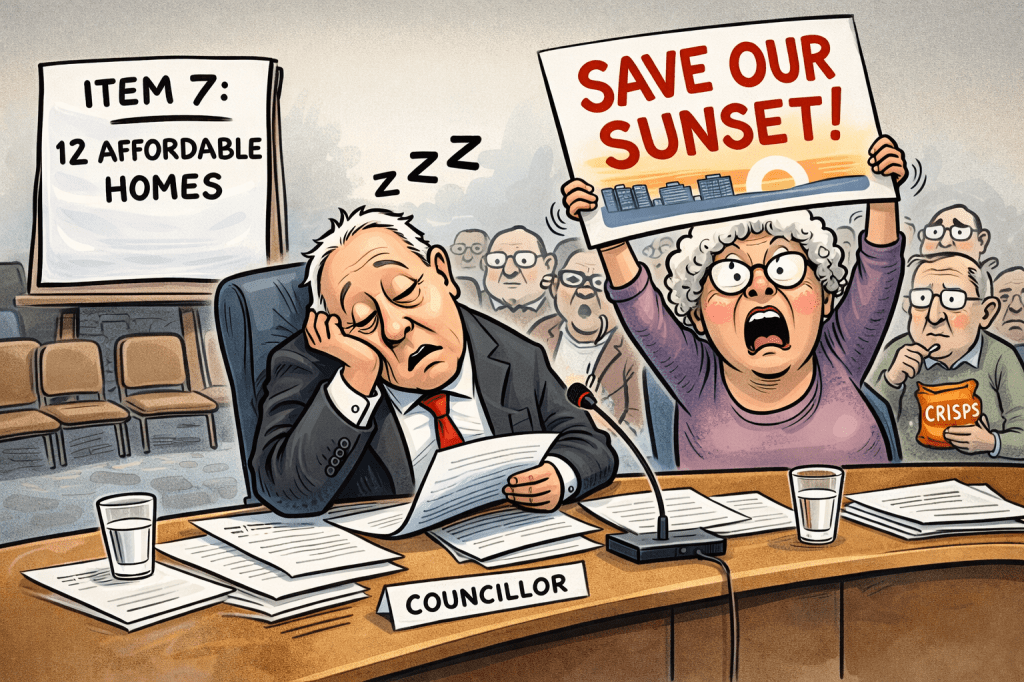
    Instead, I’ve watched meetings where the Chairwoman nodded off mid-way through a major application. Where councillors fumbled through speeches they clearly didn’t write — usually provided by the local pressure group. Where “debate” means repeating the same handful of buzzwords: overdevelopment, traffic, flooding, character. Always character.

    The audience is often made up of retirees who’ve been to more planning meetings than the committee itself. They know when to tut. They know when to mutter “disgraceful.” Some bring sandwiches.

    Applications are “called in” for no better reason than local outrage. Evidence is treated with suspicion. Emotions run high. Facebook posts are read out as if they carried legal weight.

    And too often, officers’ reports — which are detailed, balanced, and policy-driven — are ignored in favour of a speech from someone who once saw a hedgehog on the site.

    This is not democratic planning. It’s crowd management in a cold room.


    Responsive, Not Representative

    The uncomfortable truth is that committees are not genuinely representative. They are responsive — to the noisiest campaigners, the angriest objectors, the most politically inconvenient headlines.

    Public objections are a vital part of the process, of course. But we’ve reached a point where planning decisions hinge less on material considerations and more on who has the loudest WhatsApp group.

    It’s a system that rewards drama over detail.

    Councillors are under pressure. Many are doing their best. But when fear of political fallout trumps policy, and when decisions are based on heat rather than light, then we’ve stopped making planning decisions — we’re just managing optics.


    There Is Another Way

    I’ve seen a different model. I’ve worked with the Development Corporation in Tees Valley, where decisions are taken by appointed officers — often consultants — under delegated authority. No committees. No political theatre. No ritualistic objections.

    Decisions are taken within eight weeks. They are evidence-based, policy-led, and thoroughly documented. You may not always agree with the outcome, but you can follow the reasoning. You can trace the logic.

    It works. Because it’s designed to work.

    It’s not revolutionary. It’s just… planning.


    What’s the Point of Committees, Then?

    That’s the question we need to ask — bluntly.

    If committees don’t consistently improve decisions, or speed them up, or make them fairer, what exactly are they adding?

    We’re clinging to a format that’s visibly buckling. A structure that belongs to an age before online engagement, before plan-led systems, before clear policy frameworks. We treat committee meetings as sacred, even as they deliver delays, reversals, and the kind of decisions that make judicial review lawyers rub their hands together.


    What Might a Hybrid Model Look Like?

    This isn’t about removing elected oversight — it’s about making it work.

    A reformed system might mean:

    • Most decisions delegated to officers under clear policy frameworks.
    • Panels of trained decision-makers, with members held to basic standards of competence.
    • Clear protocols for engagement, scrutiny, and transparency — without the theatre.

    If you insist on “localism,” at least make it literate.

    We wouldn’t allow a councillor to vote on a licensing board without training. Yet we let them determine multi-million-pound developments based on what they saw during a site visit through the bus window.


    Closing Thoughts

    I’ve lost count of the meetings that ended in confusion, anger, or absurd compromise. I’ve heard refusals justified on grounds so flimsy they collapsed at appeal before the ink was dry. I’ve watched professional advice tossed aside because someone feared their election leaflet.

    This isn’t democracy. It’s performance. Performance with consequences.

    So let’s be honest: if we designed a planning system from scratch tomorrow, would anyone seriously propose… this?

    It’s time to stop pretending planning committees, in their current form, are working. We can preserve democratic principles without preserving pantomime.

    And we owe it to everyone — applicants, residents, and planners alike — to make decisions that are better than this.

  • Inoffensive by Design: How ‘Character’ Is Killing Character

    New housing is timid. Not understated. Not elegant. Just timid.

    We talk endlessly about respecting “local character” as if it were some sacred text — one we must interpret carefully and never deviate from. But more often than not, “character” is just shorthand for “don’t frighten the neighbours.”

    The result? Entire estates that could have been built anywhere. Three-bed boxes in compliant red brick. Token gables. Faux chimneys. Heritage by spreadsheet.

    And all in the name of “context”.

    We’ve mistaken repetition for reverence. Somewhere along the way, “contextual” became a synonym for “copy-paste.”


    What Do We Even Mean by ‘Character’?

    Let’s be honest — nobody really knows.

    Is it style? Materials? Roof pitch? Is it the curve of the road, or the fact that there’s no pavement on one side? Is it the view of the church spire from a layby near the recycling bins?

    Ask ten planners and you’ll get ten definitions. Ask a committee and you’ll get a leaflet quote.

    “Character” has become a convenient umbrella for objectors, officers and councillors alike. It’s used to oppose the unfamiliar, resist the modern, and excuse the dull. Sometimes all three.

    We throw it around like it’s quantifiable. But what we’re really doing is policing anything that dares to stand out.


    The Real Consequence: Timid Design

    Developers, understandably, play it safe. Why risk bold design if it means delay, committee, and a possible refusal? Why go near “contemporary” when it only takes one councillor to call it “out of keeping”?

    So we end up with endless applications that blend into a beige sea of inoffensiveness. Streets designed not for place-making, but for avoidance. Avoidance of controversy, of risk, of anything that might require explanation.

    Planners don’t help. Too many design comments focus on whether something “respects the grain” or “reflects the prevailing vernacular.” Too few ask whether it’s any good.

    The result is housing that looks like it was assembled from a nationwide kit — the same porches, the same window proportions, the same brick-effect panels.

    It’s not protecting local identity. It’s manufacturing national monotony.

    And let’s be clear — we’re not preserving history here. We’re preserving mediocrity. We’re holding up 1930s suburbia like it’s some kind of design benchmark, when half of it was built without a shred of architectural ambition.


    A Word on Design Codes

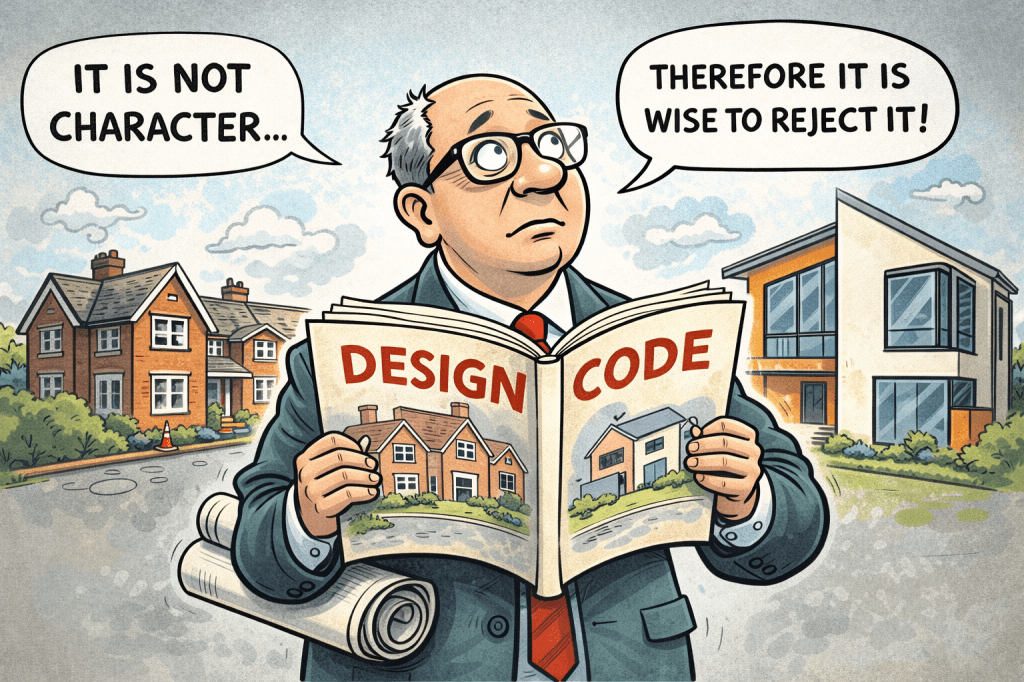
    Design codes aren’t the villain. When used well, they raise standards, give clarity, and stop the worst excesses.

    But when followed rigidly — or written to pander — they stifle imagination. They produce developments that tick boxes, avoid objections, and utterly fail to excite.

    We’ve created a planning culture where the path of least resistance is always the path of least quality.

    If a developer wants to try something genuinely different, they don’t look to the code for guidance — they brace for battle.

    This is how we end up with places that have no connection to geography, climate, history, or anything human. Just the hollow reassurance that it looks like the last one that got through planning.


    When Did We Become So Afraid of Boldness?

    That’s the question planners, designers and councillors should be asking themselves.

    When did bold design become so threatening?
    When did we decide that anything striking was “out of character”?
    When did place-making give way to appeasement?

    Not everything needs to be iconic. But we ought to expect something that reflects the time it was built in. A willingness to speak the language of today, not whisper through the voice of the past.

    Because if we only ever build to imitate, what will future generations look back on and say: yes — that was ours?

    There’s a danger in overstatement, yes. But there’s just as much danger in perpetual understatement. We’re raising entire communities without architectural identity, then wondering why they feel disconnected and unloved.


    Closing Thoughts

    This obsession with character — this fear of straying from it — has robbed us of architectural courage.

    I was a partner in an architectural firm for 5 years. In that time I moved from safe design principles to a far bolder approach. My success rate amongst LPA’s dropped from around 90% to nearer 60% in those 5 years.

    But bold design is not about erasing the past. It’s about building the present. A present that’s confident, specific, and unapologetically of its time.

    Let’s be clear-eyed: most new housing doesn’t “respect local character.” It mimics a softened version of a version of a version. It’s a photocopy of familiarity.

    And it’s dull.

    Respecting context doesn’t mean copying it. It means engaging with it — responding to it — and sometimes challenging it.

    Because if we never take a risk, we’ll never build anything worth remembering.

  • Brief Encounters: A Planner’s Homage to the Barristers Who Save – and Occasionally Sink – Us

    Planning barristers are a bit like the espresso shot in your professional coffee — intense, essential, and likely to keep you awake at night.

    They arrive, often with minimal warning, to skim-read the case file you’ve been tenderly nursing for six months, and somehow pronounce it “straightforward”. They cross-examine ecologists with the delicacy of a raptor. They conjure statutory interpretation from thin air. They quote paragraph 174(b) of the NPPF as if it were poetry. And, with terrifying regularity, they are right.

    This is, of course, maddening.

    And yet, we remain in awe.

    This article is a small, tongue-in-cheek tribute to that rare breed of legal professional who can summarise an entire Local Plan, pick holes in your policy reasoning, and still find time to demand a sandwich of “appropriate gravitas” during the lunch break.

    It’s also an introduction to a new book – a farcical, affectionate, and occasionally savage tale set in the world of planning law. A world many of us know, and some of us would rather forget.

    But first, let us raise a rhetorical glass to the planning barristers who make our lives both easier and infinitely more complicated.


    The File Whisperers

    There is something faintly wizard-like about the way a seasoned KC can materialise at a public inquiry and, within hours, distil hundreds of pages of environmental assessments, transport modelling, and emotional representations into a coherent legal argument.

    You’ve been wrestling with the biodiversity net gain matrix for weeks. They glance at it and say, “Ah, we’ll run that as a point on mitigation hierarchy. Cross-examination at 11:10.”

    You flinch, blink, and briefly contemplate moving to the leisure team.

    To watch a barrister dissect a policy conflict in real time is to witness both brilliance and bloodsport. It’s thrilling. It’s awful. It’s often exactly what’s needed. They are, in their purest form, the oracles of the planning system – if the oracles had strong opinions about visibility splays.


    Love, Hate, Law

    The relationship between planning officers and planning counsel is complicated. You adore their clarity and loathe their condescension. You need their insight and dread their questions. They are, in short, the consultants you didn’t choose but are now legally and emotionally married to for the duration of the appeal.

    There are the moments of genuine gratitude — the night-before bundling session where your silk calmly rewrites your week’s worth of witness notes and says, “There. Now it sounds as though someone meant it.”

    There are also the darker hours — the times your counsel casually suggests that your enforcement case might be “optimistic”, or that your housing land supply figures appear to have been “assembled by optimistic squirrels”.

    They don’t mean to wound. It’s just that many have spent twenty years in a profession where pointing out someone else’s failure is considered polite conversation.

    And then, of course, there are the moments you wish — viscerally, vengefully — that the other side hadn’t instructed counsel. The kind of inquiry where a seemingly benign landscape architect is reduced to tears under cross-examination. The kind where a single KC manages to convince the Inspector that a caravan park is, in fact, a form of heritage-led regeneration.

    But the truth is, when it all goes wrong, the barrister is often the one standing in front of the train. Even if they’ve first reminded you that the train is your fault.


    Introducing Roddy Bickerstaff KC

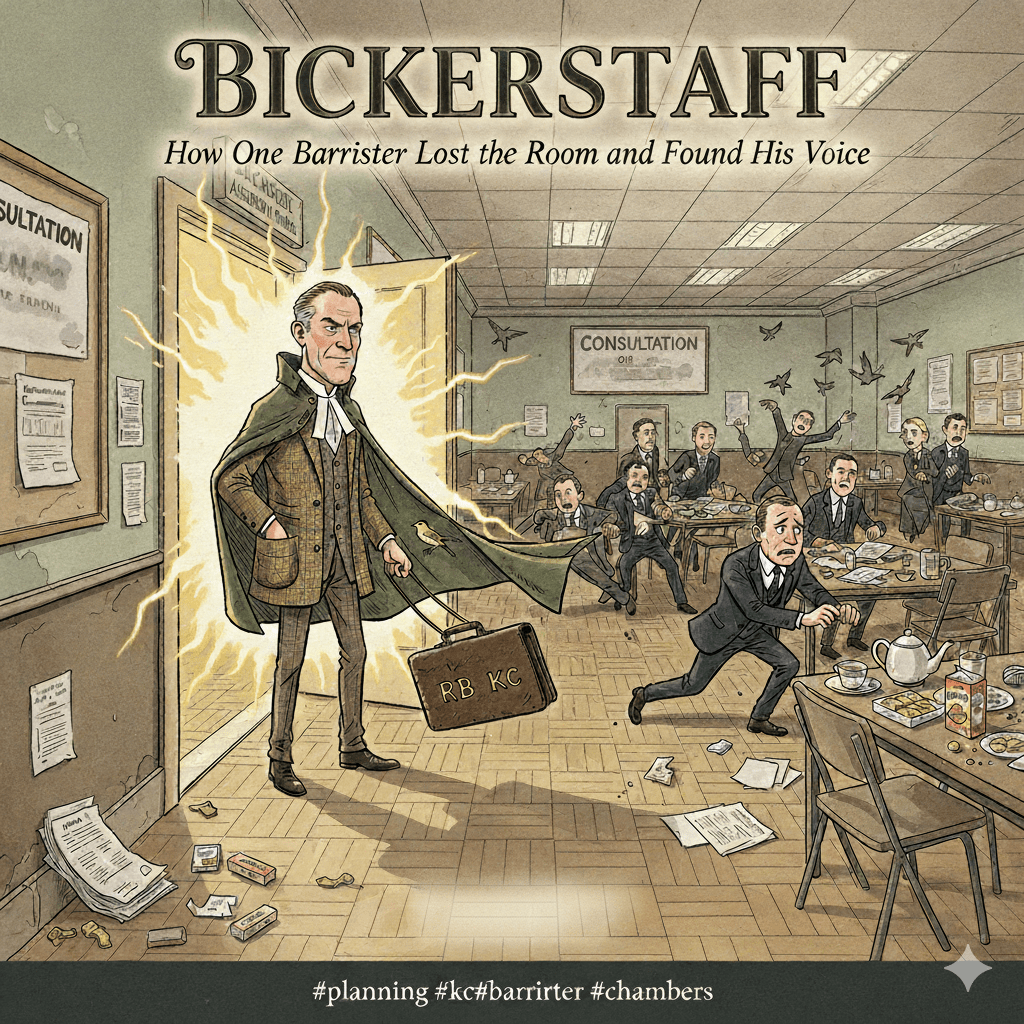
    It is into this absurd and strangely noble world that we drop Roddy Bickerstaff KC — the star of Bickerstaff: How One Barrister Lost the Room and Found His Voice.

    Roddy is a creature of courtroom ritual, all school tie and contempt. He thrives on superiority, despises snacks, and believes most junior barristers to be a regrettable administrative error.

    At least, until he forgets to mute his microphone.

    The book opens at a planning inquiry in Bakewell, where Roddy arrives with all the subtlety of a thunderstorm. He belittles his junior, insults the witnesses, and delivers a scathing commentary on the very process that employs him – unaware he’s doing it live. To the nation….on the red button.

    The consequences unravel across chambers, social media, and the entire legal profession.

    At the heart of the story is a relationship familiar to anyone in the profession: the barrister and the junior. Or in this case, the tyrant and the intern. What begins as a satire on arrogance slowly shifts into something more surprising — a meditation on professional redemption, the shifting power of truth, and the quiet dignity of those who spend their careers being overlooked.

    And yes, there are skylarks.


    An Extract: Thunderclap in Tweed

    To give a flavour, here is a paragraph from Chapter One – the infamous Bakewell inquiry. This is how Roddy arrives:

    “Roddy Bickerstaff KC did not so much enter the Assembly Rooms as impose his will upon them. He appeared in the doorway like a thunderclap in tweed — all shoulder-rolling superiority and the swish of expensive fabric, a Barbour cloak of invincibility half-cocked like a matador’s cape. His briefcase — real leather, obviously — trailed behind him as if cowed by its own importance.

    He surveyed the room. A shoddy theatre of municipal compromise: scuffed parquet, weak tea, and wall-mounted desperation. The Bakewell Assembly Rooms were where laminated consultation boards came to die. Roddy’s lip curled with affectionate disgust.

    “Coffee,” he barked, to no one in particular.

    Somewhere behind him, junior barristers scattered like startled starlings. Kallum O’Keefe — his designated pack mule for the inquiry — peeled away, heading for the refreshments table with the downtrodden zeal of a condemned man fetching his own blindfold.”

    It goes downhill (for Roddy) and uphill (for the reader) from there.


    What’s It Really About?

    While Bickerstaff is a comedy — sometimes farce, sometimes satire — it’s ultimately a book about voice.

    Who gets to speak? Who is heard? And what happens when the silent people finally find their audience?

    It’s about the power imbalance between silks and juniors, consultants and case officers, planning committees and the people who prepare the minutes.

    It’s also, unashamedly, about the joy and terror of the public inquiry. That glorious circus of opinion, policy, and shortbread. The book loves it as much as it mocks it.

    There are no villains in this story. Only professionals – tired, principled, flawed – trying to do their jobs under the flickering light of scrutiny. Some rise. Some fall. All are recognisable.


    Who Should Read It

    If you’ve ever briefed a barrister and then had to apologise for the size of the evidence folder – this is for you.

    If you’ve ever winced at a late-night email about the phrasing of a condition – this is for you.

    If you’ve ever sat in a draughty hall and wondered how this became your career – then welcome. You’re among friends.

    It’s for the legal profession. The planning profession. The underpaid, the over-prepared, and the quietly brilliant.

    And yes, it’s especially for the juniors.


    Final Submission

    Bickerstaff: How One Barrister Lost the Room and Found His Voice is available now. It contains Latin, sarcasm, hedgerows, and the finest fictional inquiry Bakewell has ever seen.

    If you’ve ever wanted a satirical backstage pass to the world of planning law — this is it.

    Inspector, I rest my case.

    #planning #kc #barrister #chambers

  • The Vanishing Art of Knowing Things: Whatever Happened to the All-Round Planner?

    A reflection on memory, marbles, and the slow erosion of planning as a craft.

    I remember attending a parish council meeting with the Director, back in the halcyon days when I still had full control of my cognitive filing cabinet. I’d worked that patch for five years. I knew the landowners, the lay-bys, the footpaths, and which councillor had a particular allergy to external cladding.

    It was one of those moments we rarely get anymore: walking into a room, and not only knowing what the current application said, but what the last one said, and the one before that. Knowing the objections raised in 2013, who raised them, and what the Chair of Planning had muttered about it under his breath while pretending to read the officer’s report.

    The Director came to observe. I came to perform. Questions flew – policy references, procedural nuance, historical context. I answered them all, not with bombast, but with certainty. It was like being a GP who could diagnose the condition, recall treating the patient’s brother three years ago, and still had time to ask how the allotment was doing.

    And the parish councillors? Well, they were stunned. Not because I dazzled them with jargon – but because I understood. The legislation. The context. The village. The planning history. The people.

    Back then, my brain was like a clean white plate with a few well-placed marbles. Each marble had room to roll – purposefully, elegantly. These days, of course, the plate is a riot. Marbles everywhere. A dozen daily updates to the NPPF, half-heard briefings on nutrient neutrality, a flurry of Teams invites from five overlapping departments, and a planning portal that occasionally seems to delete applications just for the thrill of it. Every new marble knocks another one off the edge – usually something important, like what a “conservation area” actually is.

    But here’s the thing. I can cope. I had twenty years of plate space before the marble tsunami arrived. I had time to learn.


    Why Aren’t Junior Planners Getting There?

    And this is the part that’s been needling me.

    The young planners I work with (on both sides) – bright, sharp, willing – don’t get to that moment of clarity. They don’t get five years on a patch. They don’t get time to dig in, reflect, or ask “why?”. They know how to process an application, sure. They understand the system that’s been handed to them. But the broader context? The craft? The quiet confidence that comes from knowing place, not just policy? That’s vanishing.

    Why?

    Because we’ve built a system that rewards task-completion, not understanding. Specialisation is prized over synthesis. We train planners to handle their bit, then pass the parcel. Biodiversity? That’s the ecologist’s job. Design? Send it to urban design. Public comments? Filter, summarise, move on. And so the planner becomes a relay runner – sprinting with a small section of the baton, rarely seeing the full race.

    And we wonder why decisions are inconsistent. Why officers are burned out. Why community trust is low. Why we churn staff faster than a poorly mixed concrete pour.


    The Lost Joy of Professional Mastery

    Here’s a truth we don’t say out loud: it’s immensely satisfying to be good at this job. Not competent. Good. To know your policy base and your patch. To stand in front of a committee or a community and feel that grounded confidence. That only comes with time, and more importantly – with opportunity.

    It doesn’t come from watching a webinar. It comes from watching a planning committee over five years and noticing which councillor is obsessed with traffic, which one trusts officers implicitly, and which one once got bitten by a bat and now distrusts all ecological reports on principle.

    It comes from mentoring. From the thousand informal conversations in the car park or the lunchroom, where you realise that planning isn’t just about development – it’s about place. It’s about people.

    And crucially – it comes from not being overloaded to the point of paralysis.


    Can We Fix It? (Not With a 3-Month Graduate Scheme)

    I don’t want this to be another nostalgic moan from someone who remembers when development management was called “development control” and no one had discovered “deliverability” as a weaponised word.

    But I do want us to ask: are we raising planners, or processing officers?

    Are we giving them the time, the space, and the encouragement to become proper planners – the kind who could walk into a village hall and remember what happened in 2009, and why the hedgerow mattered?

    Here’s a radical suggestion:

    • Let juniors stay on patches for more than six minutes.
    • Encourage them to read old files – not because they have to, but because they want to understand.
    • Pair them with old warhorses who’ve been through three local plans, one reorganisation and a mysterious incident involving an over-zealous parish clerk and a hand-painted footpath sign.
    • Celebrate generalists. Honour memory. Stop acting like the only kind of professional is a specialist.

    Let the Marbles Settle

    We need more planners who know why they’re doing what they’re doing – not just what checkboxes to tick.

    Because without that, we’re not really planners at all. We’re administrators of policy PDFs.

    And one day, when the last generalist retires, we’ll realise we’ve lost something that can’t be replaced with a template.

    So here’s to the plate. To the marbles. And to making space again – for memory, meaning, and the joy of being bloody good at what you do.

    Footnote (for the keen, the curious, or the currently coasting):

    It’s only fair to admit that when I started out, I was hopeless.

    After five years at university – the majority of which was spent at the bar (and not the useful legal kind) – I arrived in my first planning job with the professional focus of a houseplant. I hadn’t read a single policy document. I certainly hadn’t read the GDO (as it was quaintly called then – no reference to “permitted development rights” back in those days). I thought “Article 4” was possibly a treaty.

    But I was lucky. I had a Chief Planner who told me, quite bluntly, to go off and read. I had a colleague who understood time management and could spot nonsense at fifty paces. And I had the time – and just enough self-awareness – to realise I needed to put in the work. I also had a newly born son (who is now mid 30’s), and the creeping realisation that if I didn’t get my act together, I’d be explaining the difference between outline and full permission while stacking shelves at night.

    So I made the decision: to stop bluffing, start learning, and get good at the job.

    And that’s what I’d say now to anyone at the start of their planning career: look around the room. Then quietly resolve to get better than every single person in it.

    Not in a smug way. Not in a political way. Just in the quiet, competent, bloody-useful kind of way.

    Be the person others come to for advice. Be the one who remembers, who understands, who joins the dots. And then one day – probably without even noticing – you’ll become the planner people trust.

    And if you do that… you might just start enjoying this job more than you expected.